Overview
This is a memo about trying out the “Tale of Genji in Textbooks LOD” (Kyokasho no Naka no Genji Monogatari LOD).
https://linkdata.org/work/rdf1s10294i
It is described as follows.
The “Tale of Genji in Textbooks LOD” is an LOD conversion of data on The Tale of Genji published in post-war authorized textbooks for the classical literature section of high schools.
I would like to thank all those involved in creating and publishing the “Tale of Genji in Textbooks LOD”.
Creating a SPARQL Endpoint
This time we use DyDra. We registered the data using Python, referencing the following article.
As a note, the URIs in the RDF had a mixture of http://linkdata.org/resource/rdf1s10294i# and https://linkdata.org/resource/rdf1s10294i#. This time, I performed a replacement to unify them to http://linkdata.org/resource/rdf1s10294i# before registering them in the SPARQL endpoint.
Verification with Snorql
I created a Snorql instance to query the constructed SPARQL endpoint.
https://nakamura196.github.io/snorql_examples/genji/
For example, in the following, textbooks using the Kiritsubo chapter are linked via schema:workExample.

In the following, chapters published in the textbook “Koto Kobun 3” are linked via dct:hasPart.

Visualization with Yasgui
I also tried visualization using Yasgui. For more information about Yasgui, please refer to the following.
Counting Chapters per Textbook

Counting Textbooks per Chapter

We can see that “Kiritsubo” is included in the most textbooks.
Number of Textbooks per Authorization Year
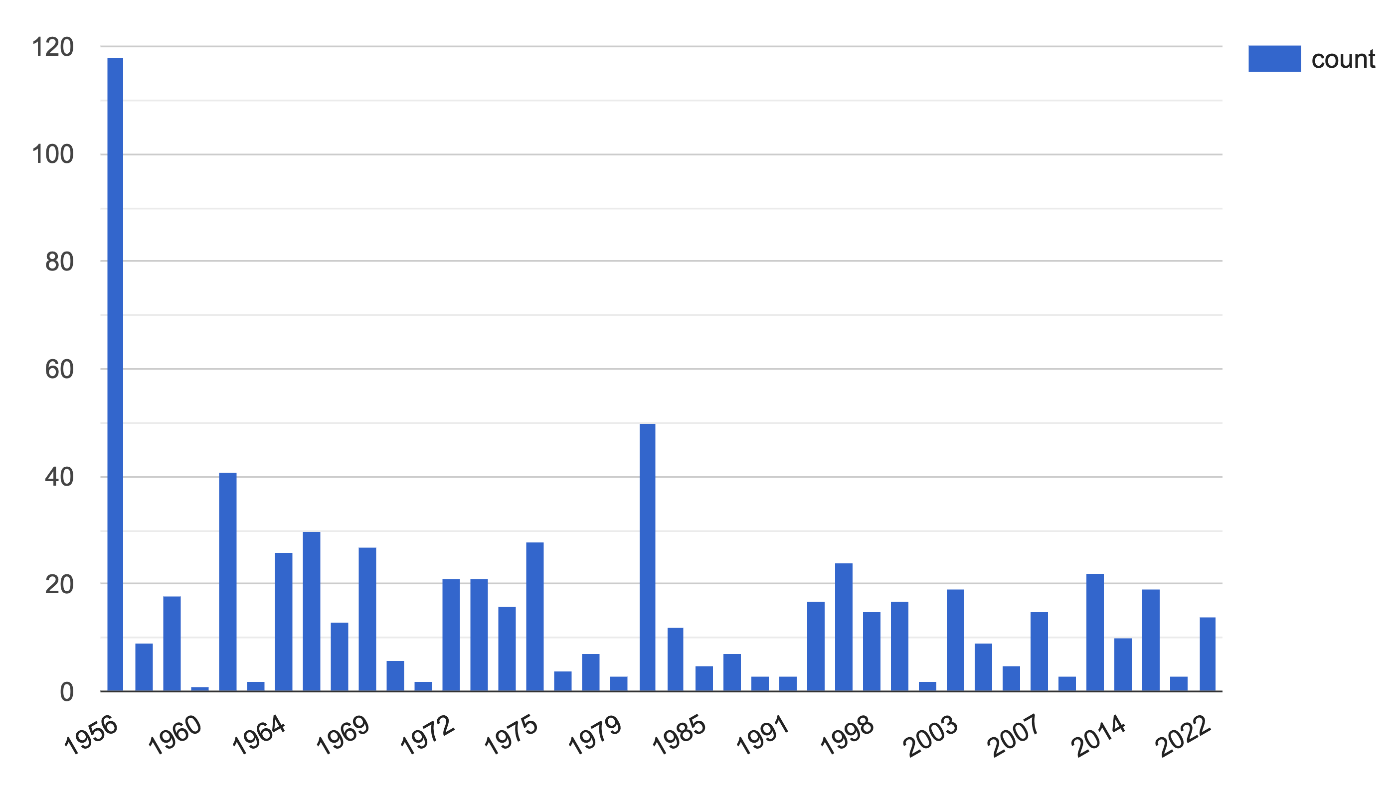
Please note that there are gaps (missing years) on the X axis.
Relationship Between Publishers and Textbooks
This is limited to textbooks that include the Kiritsubo chapter.


While there may be more effective visualization methods, you can view a list of textbooks by publisher.
Summary
There may be some points where my understanding of the RDF data content is incorrect, but I hope this serves as a useful reference for using the “Tale of Genji in Textbooks LOD” and various LOD-related tools.