Overview
The GitHub repository for grlc is as follows.
https://github.com/CLARIAH/grlc
It is described as follows.
grlc, the git repository linked data API constructor, automatically builds Web APIs using shared SPARQL queries.
I tried out this tool, so here are my notes.
The API endpoint created targeting the Japan Search SPARQL Endpoint is as follows.
https://grlc.io/api-git/nakamura196/grlc-jps
Background
While researching Odeuropa, I found this tool mentioned on the following page.
https://odeuropa.eu/nosebooks/
Usage
The following is the GitHub repository created for this API.
https://github.com/nakamura196/grlc-jps
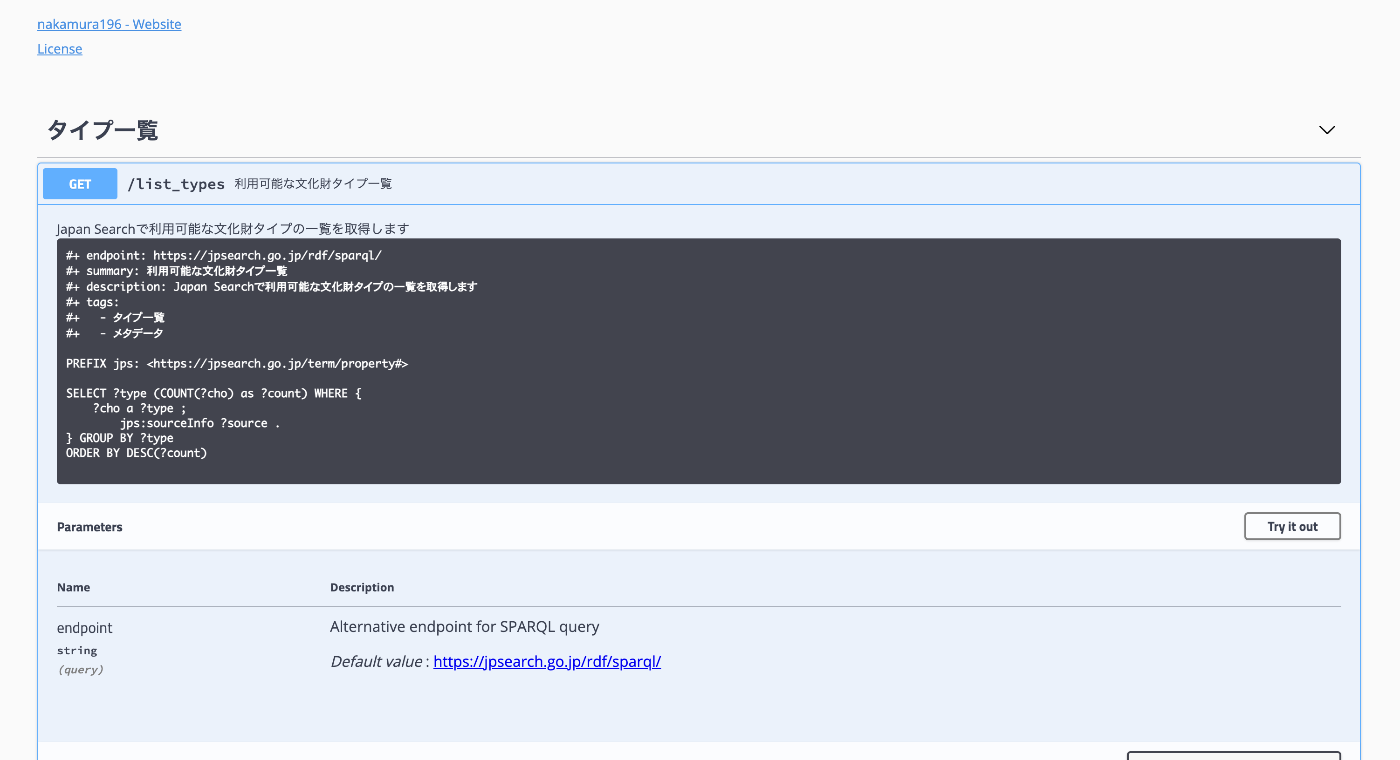
For example, the following is a SPARQL query for an API that retrieves a list of types.
It appeared that by using decorator syntax, you can specify values to display and configure in swagger-ui.
By preparing such rq files, the following swagger-ui was created.
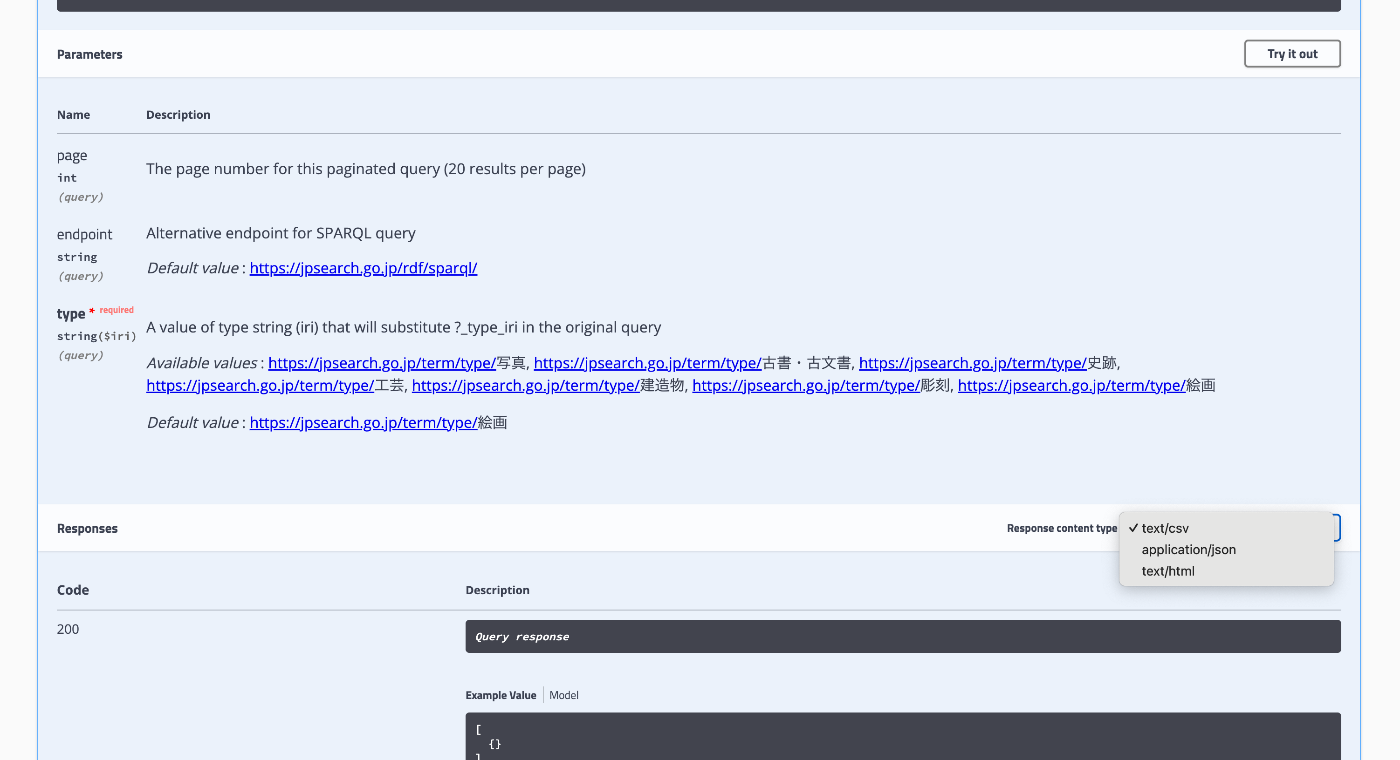
Additionally, I was able to perform pagination, query changes, and output format changes (csv, json, html) as shown below.
Notes
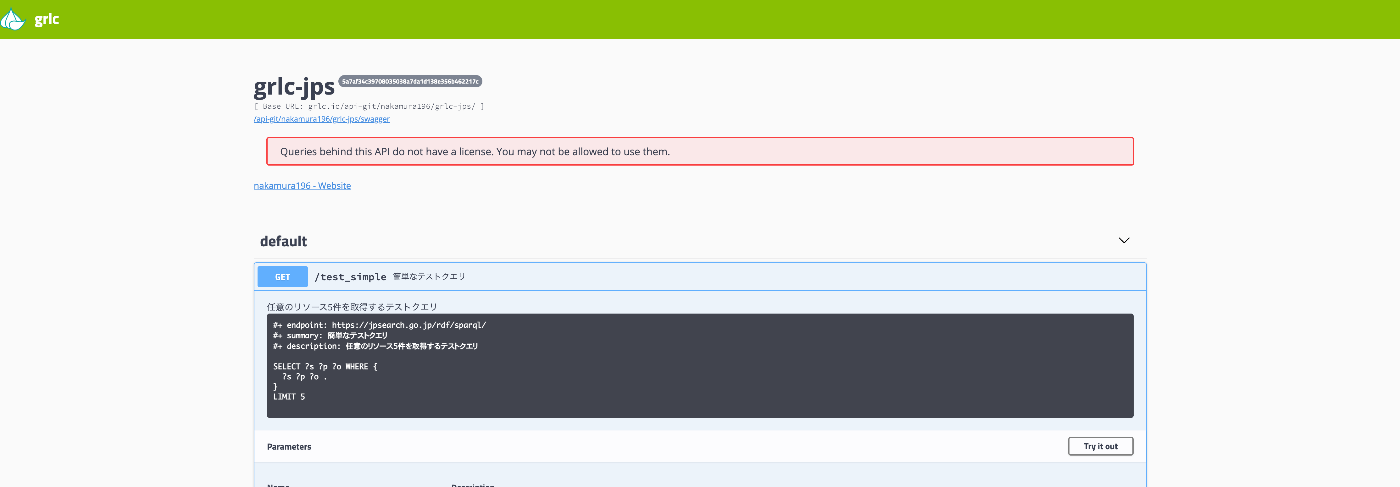
When there was no LICENSE file, an alert was displayed as shown below. Adding a LICENSE file resolved the issue.
Summary
grlc is described as follows.
grlc is a lightweight server that takes SPARQL queries (stored in a GitHub or GitLab repository, in your local filesystem, or listed in a URL), and translates them to Linked Data Web APIs. This enables universal access to Linked Data. Users are not required to know SPARQL to query their data, but instead can access a web API.
As described above, I found this tool useful for interacting with users who are not familiar with SPARQL.
I hope this serves as a helpful reference for applying RDF.